About This Episode
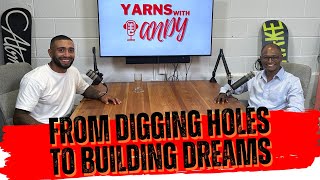
Caleb Male is a New Zealand civil contractor with an unusual pairing of backgrounds, earthworks and environmental science, and the founder of civil contracting company Kenai (named after the Kenai Peninsula in Alaska, where he was born before his family returned to Rotorua). He tells his founder's journey: an environmental science start doing nitrogen budgeting for Bay of Plenty Regional Council, three years running the family forestry-harvest business after his father passed away, seven years at Watercare (arriving as a tier-3 contractor under Fulton Hogan on phase one of the Puketutu Island landfill rehabilitation), and the COVID-2020 reflection that pushed him to start his own "modern contractor." The conversation's spine is Caleb's thesis that ESG (environmental, social, governance) should be embedded into daily site delivery rather than bolted on as a tick-box tender exercise, Kenai tracks water, fuel, energy, carbon and waste-diversion metrics and runs an electric digger. Andy and Caleb then range across the broken market (lowest-cost-conforming tenders, NZ as a "price-driven country"), the ten-year consent problem, the absence of a funded infrastructure pipeline and long-term national vision, and the loss of talent to Australia, closing on founder lessons about slower growth, hiring for attitude, and staying true to the vision through the downturn.
Key Topics Discussed
- The Kenai origin and the "modern contractor" thesis. company named after the Kenai Peninsula, Alaska; the idea is a data-and-metrics-driven contractor that embeds sustainability into everyday delivery rather than treating it as a separate tick-box.
- Puketutu Island rehabilitation (Watercare). an old quarry next to Auckland Airport / Māngere being reformed with biosolids into a regional park "bigger than Cornwall Park"; ~3.3 million cubic metres moved; just-in-time build program; quality and safety paramount because "once you've filled it, you've filled it" and a liner leak is permanent. Consent said to run to ~2035; described as one of the hardest consents ever obtained.
- ESG operationalised. the three pillars (environmental / social / governance) tracked via cloud-based systems (moved off Excel): water usage and type, on/off-site energy, fuel vs electric-digger carbon footprint, waste diversion and separation, material tracking. Andy frames it as an ETL problem (extract-transform-load), logging five years of data, then turning it into long-term investment decisions.
- Waste diversion as low-hanging fruit. fewer truckloads, more reuse: lower carbon, lower cost to the customer, safer (fewer movements).
- Electric digger economics. high capital cost but cheap to run; fuel-price shocks accelerate payback; unintended benefit that crews can talk to each other outside the cab because it is quiet.
- The ten-year consent problem. Caleb and Andy agree consents take far too long ("apply now, get it when my 8-year-old goes to university"); a lot changes in ten years and certainty is never achievable anyway.
- Price vs value / broken procurement. the market is driven by lowest-cost-conforming tenders, eroding margin and the ability to invest in people, innovation and ESG; NZ is "a price-driven country" (the Warehouse analogy); reducing margin is not a long-term strategy.
- No funded pipeline, no vision. a "list of projects" is not a vision or a funded pipeline; election cycles drive boom-bust; call for longer cycles / bipartisan commitment; NZ lacks a 20-year vision (connected Auckland, the Golden Triangle: Auckland-Hamilton-Tauranga).
- Talent retention / brain drain. Australia pays $30-40k more; NZ trains people then "kicks them over the ditch"; Kenai hires for attitude ("you can't train attitude") and brings people into a longer-term vision.
- Three asks of a Minister of Construction. (1) a guaranteed funded pipeline, (2) a framework to train people / bring apprenticeships back, (3) a longer-term vision where sustainability and value (not lowest cost) turn the dial.
- Founder lessons. if restarting Kenai: grow slower, be more disciplined on capital allocation, stay local (build a solid Auckland foothold, make mistakes in one place) before expanding into every region; starting in a boom was the easy bit, the lessons come when the market slows; make decisions earlier; stay true to who you are ("broad shoulders").
Notable Quotes
- "We're not going to be going back down to fix a hole in a liner … once you've filled it, you've filled it.", Caleb Male (on quality at Puketutu)
- "Adding value is … it's a myth that it's lowest cost. Absolute myth.", Caleb Male
- "We've got a list of projects, that's not a vision.", exchange between Caleb Male and Andy on the pipeline
- "You can't train attitude … you can teach them any skill, but you cannot teach them attitude.", Caleb Male
- "At the moment we're burning assets, that's not an investment strategy, that's just pushing the problem down the road.", Caleb Male (Andy: "I couldn't have said it better.")
Guest Background
Caleb Male grew up in Rotorua ("a Roa boy," Rotorua Boys High) but was born in Alaska (Kenai Peninsula), the source of his company's name, with his family returning to New Zealand when he was young. His environmental passion came from an outdoors upbringing (forestry blocks, rivers, lakes, sea) and a small family business background. He studied environmental science and worked on nitrogen budgeting for Bay of Plenty Regional Council, then took over the family forestry-harvest business for about three years after his father passed away. He moved to Auckland, joined Watercare as a tier-3 contractor under Fulton Hogan on phase one of the Puketutu Island project, and stayed roughly seven years, learning delivery at scale. During the 2020 COVID period of reflection he left to found Kenai, a civil contracting company built around ESG values; at the time of recording Kenai is about five years old. He has a son who is eight. Hunting, fishing and walking his dogs are the weekend spaces he wants kept clean, the personal root of his environmental drive.