Panel
About This Episode
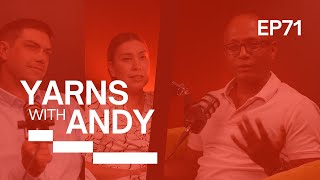
The first panel episode of Yarns with Andy, and the dispositive moment Andy himself names as the inflection point of the podcast. Four returning guests sit together for the first time: Raine Selles (Ep 10) the dual-qualified QS / construction-law specialist; James Hunt (Ep 2) the project-controls + risk specialist with UK GRIP background; Martin Edwards (Ep 6) the avionics-trained vertical-buildings methodologist + ECI / PCSA advocate; Matt Stanford (Ep 4) the Pipeline & Civil Tier-2 pre-contracts manager living the day-to-day procurement reality. Andy's framing on intro: "all of these people have been on my podcast individually… James who manages risk on all the projects, Martin focused on the front end, Matt living the procurement nightmare." Twenty minutes in, the unanimous diagnosis crystallises: NZ procurement is NOT effective. All four panellists, "people who spend most of their working lives on opposite sides of the table," agree on every substantive point. Andy poses the yes/no question directly. Raine: "No." James: "Well, clearly not." Martin: "Fundamentally, no." Matt: "Yeah. No, we definitely have some issues." This is the moment Chapter 1 ("The Adversarial Tax") opens with, the moment the podcast stops being conversation and starts being post-mortem. The panel produces the headline statistic: Raine: "700 disputes in 11 years that I've worked on, a few billion dollars worth of disputes have all been fixed price lump sum contracts." Not most. All. James adds the structural counterpoint: NZ alliances enter at 30% design with 5% risk budget; UK GRIP at 35% design expects 20% risk + 25%/-10% variance. Same level of unknowns; 4× different risk provision. Matt provides the operational reality: Tier-2 subs get 2-3 weeks to price $10M packages with incomplete information while "non-price attributes are just out the gate. Lowest price." Martin contrasts UK practice: "Contractors price off a coordinated bill of quantities; here the consultants seem to work in silos. There doesn't seem to be any coordination between the consultants… therefore there's no coordination between the drawings either." James names the human cost: a senior leader at a large construction company quit after 25 years because his organisation put a subcontractor out of business, "I've been with this organization 25 years and I've never put anyone out of business." Raine catalogues the engineer-to-contract failure mode: she has 22 active disputes at recording time, has terminated 2 contracts, and is dealing with one matter where the principal asked the engineer-to-contract to deduct liquidated damages a year before the completion date was due because they thought the contractor might be late. The panel closes on collaboration as the only durable answer, but James sounds the warning: "I just want to be the negative guy. You need a 10th man… is there true collaboration?"
Key Topics Discussed
- The "Wild West" framing, Raine's opening line. verbatim, line 11: "I've just met the Wild West. Eleven years on, I haven't really changed my opinion very much. You know, things are not improving. In fact, they seem to be getting worse." This is Chapter 1's atmospheric anchor.
- The yes/no panel verdict on NZ procurement effectiveness. Andy: "Yes or no, is the procurement process in New Zealand effective?" Raine: "No." James: "Well, clearly not." Martin: "Fundamentally, no." Matt: "We definitely have some issues." Four panellists, four agreements, in a podcast format that has never produced unanimous panel verdicts before or since.
- 700 disputes in 11 years, ALL fixed-price lump-sum. Raine's headline statistic, verbatim line 99. Foundation stat for entire Chapter 1.
- The 60-70% design + lump sum problem. Raine: "They go out to tender on the basis of maybe a 60-70% design wanting a lump sum… It doesn't take a rocket scientist to figure out that if you go out and want a lump sum price on a 60-70% design, you're not going to be budgeting properly in the first place." Martin's complement: NZ consultants work in silos producing uncoordinated documents.
- NZ 5% risk budget vs UK GRIP 20%, James Hunt. UK GRIP (Guide to Railway Investment Programming) 9-stage system; at Stage 4 (~35% design), expects 20% risk assessment + 25%/-10% variance. NZ alliances at 30% design with 5% risk budget. 4× less risk provision than UK on the same level of unknowns.
- Behaviours vs contract form, James Hunt. "It doesn't matter what type of contract you've got if the contracting behaviours are right and fair and reasonable… it doesn't matter so much what the contract form is providing the behaviours support the right type of outcomes." A FIDIC contract with collaborative behaviours outperforms an alliance contract with combative behaviours. Foundational frame for the Brealey vs The System insight at Ep 57.
- Tier-2 sub pricing reality, Matt Stanford. "We're often given about 3 weeks, two to three weeks to prepare a price for what could be easily $10 million packages." Pipeline & Civil scope: receive late from Tier-1; digest packages; define scope; engage suppliers; price; protect commercially while remaining competitive. "Almost always as Sub Es… non-price attributes are just out the gate as low as price. Straight off."
- Coordination silos, Martin Edwards on UK vs NZ. UK contractor prices off a coordinated bill of quantities; receives a fully-coordinated set of construction drawings. NZ consultants work in silos; no coordination between drawings; "huge RFI massive lists on every single dispute." The consultant-coordination gap is the upstream source of build-only RFI dysfunction.
- The 25-year tipping point, James Hunt's story (verbatim line 299). A senior leader at a large construction company who quit after 25 years: "The thing that was his tipping point was that they put a subcontractor out of business. And he said, I've been with this organisation 25 years and I've never put anyone out of business."
- Engineer-to-contract failure mode, Raine. "Almost every single dispute that I work on, there is a problem with the engineer to the contract. I probably remove via mediation half a dozen every year for not being fit for purpose." 22 active disputes at recording; 2 terminated contracts; 1 default notice issued for "principal interference and lack of backbone by the engineer to the contract." The smoking gun: a $7M contract where the principal asked the engineer-to-contract to deduct LDs a year before the completion date was due, "as bad as it gets."
- Beechcroft Apartments reference. Raine attributes "most of the blame" on a particular engineer-to-contract who got removed.
- Independent certifier payment problem, Raine's submission. "We need to have the project pay for the CA or the independent certifier… both parties need to pay his bill" for true independence under NZS 3910:2023. Anticipates the structural separation that Ep 56 confirms NZS 3910:2023 codifies.
- Subcontracts without completion dates, Raine. UK banned retention-tied-to-main-contract in 2011. NZ subcontracts often have no completion date, "as per the contract programme" referenced where the programme doesn't exist or is months out of date.
- 3-week look-ahead programmes for subbies, Raine. "It's impossible for a subcontractor to ask an extension of time when (a) he's given a 3-week look-ahead programme and not an updated programme monthly to show what's going before him or what's going after, and (b) there's no due date for completion in his subcontract."
- PCSA / ECI as the answer, all four agree. Matt: "If we're all batting for the same side at the front end… we decide all the risks together. We decide what the programme looks like together. Bring in experts from every field." Martin: "PCSA / ECI try and get some involvement far earlier in the piece." James: alliance-style collaboration with risk-shared models.
- The "10th man" warning, James Hunt's caveat. "I just want to be the negative guy. You need a 10th man in everywhere." True collaboration is rare even on alliances designed for it; behaviours not labels determine outcomes.
- NZS 3910:2023 split, independent certifier vs contract administrator. Raine notes the upcoming split as "the only thing changed in the update", separation of CA + IC roles. Now confirmed via Ep 56 and via the AJSV_MALAGAN_TDR contract draft (concentrated CA+IC role observation flagged as Cortex-portfolio insight).
Notable Quotes
Raine [00:32]: "I've just met the Wild West. Eleven years on, I haven't really changed my opinion very much. You know, things are not improving. In fact, they seem to be getting worse."
Raine: "700 disputes in 11 years that I've worked on, a few billion dollars worth of disputes have all been fixed price lump sum contracts."
Raine: "They go out to tender on the basis of maybe a 60-70% design wanting a lump sum… It doesn't take a rocket scientist to figure out that if you go out and want a lump sum price on a 60-70% design, you're not gonna be budgeting properly in the first place."
James Hunt: "In the UK they've got a system called the GRIP process. When you went into a design and construct at stage 4 of GRIP, which is something like a 35% design, they expected you to have a risk assessment that was returning something like 20%. And then on top of that they added plus 25 to minus 10% as a potential variance."
James Hunt: "In New Zealand we're going into alliances at 30% design with 5% risk."
James Hunt: "It doesn't matter what type of contract you've got if the contracting behaviours are right and fair and reasonable… it doesn't matter so much what the contract form is providing the behaviour supports the right type of outcomes."
James Hunt (the 25-year tipping point): "The thing that was his tipping point was that they put a subcontractor out of business. And he said, I've been with this organisation 25 years and I've never put anyone out of business."
Matt Stanford: "We're often given about 3 weeks, two to three weeks to prepare a price for what could be easily $10 million packages."
Matt Stanford: "Almost always as Sub Es… non-price attributes are just out the gate as low as price. Straight off."
Matt Stanford: "You wouldn't program an automated car factory with 60% of the design. You'd end up with… something pretty hard to drive."
Martin Edwards: "Coming from the UK, one of my biggest shocks when I got here was the fact that contractors are expected to work on uncoordinated drawings… the consultants seem to work in silos. There doesn't seem to be any coordination between the consultants and therefore… no coordination between the drawings either."
Raine: "I've had more disputes land on my desk in the last couple of months than I've had in 11 years. And that's telling of the fact that the industry just isn't working… 22 disputes on the go at the moment. I've terminated 2 contracts."
Raine (on engineer-to-contract): "Almost every single dispute that I work on, there is a problem with the engineer to the contract. I probably remove via mediation half a dozen every year for not being fit for purpose."
Raine (on the worst engineer-to-contract example): "Asking the engineer to the contract to deduct liquidated damages a year before the completion date is even due because he thinks the contractor might be late."
James Hunt: "I just want to be the negative guy. You need a 10th man in everywhere."
Andy (yes/no panel question): "Yes or no, is the procurement process in New Zealand effective?" Raine: "No." James: "Well, clearly not." Martin: "Fundamentally, no." Matt: "Yeah. No, we definitely have some issues."