Matt Stanford
About This Episode
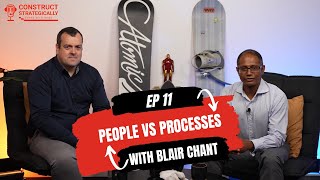
Matt Stanford joins Andy for a deep dive on WK50 (Waikato 50), the water treatment plant Andy explicitly names as "probably one of the best projects I've worked on… the first job I worked on that we finished on time", designed, procured, and built in approximately 12 months and instrumental in resolving the 2020-2021 Auckland water crisis. The conversation is structured around three substantive arguments. First, project controls and design management are support functions, not overhead, Matt's career through irrigation design-and-build instilled the philosophy that "my role in pre-contract, design or whatever it may be is to facilitate the successful construction of an asset." Second, weekly programme reviews are non-negotiable for projects with singular delivery focus, "one meeting doing backward review, then the next you have no choice but to talk about the future." Third, Last Planner integration with the master programme is the missing link, Matt initially dismissed Last Planner as too granular for the planning function, then realised the directional flow should reverse: the site team's Last Planner use should inform programme reporting and the next milestone should feed back. The episode's defining moment is the WK50 mid-project intervention, an honest realisation of 2-3 months of slippage that produced a methodology overhaul (in-situ→precast, procurement compression, off-site fabrication, night shifting) and re-baselined the programme, "facilitated through discussion not dictated." The conversation closes with material escalation (weekly steel price increases making lump-sum tenders nearly impossible, Pipeline Civil reducing tender validity to 6 weeks), labour shortages (border reopening won't be a silver bullet, young engineers are leaving NZ), and the still-unsolved subcontractor digitalisation gap (subbies receiving 2D PDFs not digital models).
Key Topics Discussed
- WK50, design, procure, build in 12 months. Auckland water-crisis context; on-time completion. Andy's framing: "probably one of the best projects I've worked on… first job I worked on that we finished on time."
- Last Planner, directional inversion. Matt's initial dismissal: "site coordination, not that valuable to the planning function." Realisation: the directional arrow reverses, site teams' Last Planner use should inform reporting and programme adjustment, then feed back the next milestone. 4-5 week look-ahead expanded to 8 weeks for WK50; integrated with master-programme milestones.
- Project Controls as support function. "Measure, manage, communicate, that's all project controls does." Not "the project team owes you things"; the inverse. "We're not just a reporting function. We're actually here to facilitate change and effective delivery."
- Weekly programme review cadence. Monthly is too laggy; weekly forces forward-looking conversations after the first cycle. Resolution-around-change is significant at weekly cadence vs monthly.
- Mid-project intervention pattern. WK50 wrap-up moment: 2-3 months slippage identified honestly with project manager. Re-baselined via: methodology change (in-situ → precast), procurement compression, off-site fabrication, night shifting. "That was probably my most rewarding part of the project."
- Design Management, constructability-first. Matt's irrigation-design-and-build origin (literally designed and installed irrigation systems himself). Carries through: design must consider how things are built, most cost-effective for client, most constructible for crews. "Those two things are normally pretty intrinsically linked."
- Labour Shortages. "Nobody's rushing back to New Zealand." Border reopening won't be a silver bullet. Young engineers leaving NZ, can't afford houses; locked down 3 years. Risk of mass departure rather than staggered turnover.
- Material escalation under COVID. Weekly steel price increases making lump-sum pricing nearly impossible. Pipeline Civil reducing tender validity down to 6 weeks. Direct connection to Ep 08 - Timo Skog supply-chain framing.
- Construction Digitalisation, subcontractor digital gap. Subbies still receiving 2D PDFs, not digital models. Massive opportunity but hard to drive from the subcontractor tier. Recurring critique through to Ep 85 - Anna who names monopoly Revit supplier as systemic blocker.
- Tier-2 vs Tier-1 contracting reality. Matt's move Fletcher → Pipeline Civil: Tier 2 = pre-contracts vs delivery; doesn't have "as much control of my destiny" pre-tender vs post-award.
- People + values matter. Matt cites Pipeline Civil's strong values + track record as why he moved. Same theme Ep 43 / Ep 57 develop.
Notable Quotes
Matt: "My role in pre-contract or design or whatever it may be is to facilitate the successful construction of an asset."
Matt: "We turn it around from being almost a perception of project controls where the project team owes you things… Our job is to help them make decisions and intervene perhaps at certain points of time to help them deliver the job. Otherwise we're just overhead that ticks boxes, and what's the point of that?"
Matt: "If you can't measure, you can't manage. So that's all project control does, you measure, you manage and you communicate."
Matt: "Programme is looked at as something that you do very early in the project, you get it ticked off, and just go and build it for the next 12 months. And everyone is looking to the end date, but they're not looking at the incremental milestones or what they should be achieving along the way."
Matt: "Those guys' use of the Last Planner should be informing our reporting and our adjustment of programme. And then we can provide the feedback to what the next milestone should be."
Matt: "Weekly programme review… you may spend one meeting doing a backward review of what's happened. But then the next meeting we've already spoken about that, now we need to talk about the future. We don't have a choice."
Matt: "Nobody's rushing back to New Zealand."
Andy: "That's probably one of the best projects I've worked on. The first job I worked on that we finished on time."
Guest Background
Matt Stanford started building irrigation systems straight out of university for a small contracting firm, designing, pricing, AND running the install crews himself. Progressed to irrigation infrastructure, then Fletcher Construction where he served as Design Manager and Project Controls Manager on WK50, the same project where he and Andy worked together. At time of recording, pre-contracts manager at Pipeline Civil (NZ Tier 2 civil contractor; same firm Hugh Goddard later runs as MD on Ep 77). Worked with Andy historically on UFB project also.
Matt also appears as a panellist on Ep 28 Procurement Panel alongside Raine Selles, James Hunt, Martin Edwards.